


Tosh Angelos is remembered primarily as Maya Angelou’s first husband, but their relationship belongs to a much earlier chapter of her life than the acclaimed books and public appearances that made her famous. They married when Angelou was a young mother finding her footing in San Francisco.
Their marriage was brief, yet it left a lasting mark: part of his surname became part of the name by which the writer, performer, and civil rights activist is known worldwide.
Tosh Angelos was Maya Angelou’s first husband, a former sailor of Greek descent who became part of her family when she was raising her son, Guy. Their brief marriage ended in the early 1950s. Angelou later adapted his surname for the professional name she used throughout her remarkable career.
Family Profile
| Attribute | Details |
|---|---|
| Full Name | Enistasious “Tosh” Angelos |
| Commonly Known As | Tosh Angelos |
| Known For | Being Maya Angelou’s first husband |
| Family Relationship | Former husband of Maya Angelou |
| Heritage | Greek descent |
| Professional Background | Former sailor; also described as a Navy electrician |
| Famous Former Spouse | Maya Angelou (1928–2014) |
| Marriage Period | Early 1950s; published dates vary |
| Marital Status With Angelou | Divorced |
| Family Connection | Father figure to Angelou’s son, Guy Johnson |
| Connection to Angelou’s Career | His surname inspired part of her professional name |
| Historical Significance | Part of Maya Angelou’s early personal and family history |
Who Was Tosh Angelos?
Tosh Angelos, identified in some biographical accounts as Enistasious “Tosh” Angelos, was a man of Greek descent who had served as a sailor. The National Women’s History Museum also describes him as an electrician in the U.S. Navy.
His public biographical record is limited compared with Angelou’s, and accounts of his background usually appear within histories of her early adulthood rather than in independent profiles of him.
The details that emerge most clearly concern his interest in books and music and his involvement with Angelou and her son. In the PBS documentary Maya Angelou: And Still I Rise, Angelou recalled that he had read widely, including Russian literature, and that she enjoyed his company.
Her recollection gives a more grounded picture of him than later descriptions that reduce him simply to the famous poet’s former spouse.

How Did Tosh Angelos Meet Maya Angelou?
Before she became Maya Angelou, she was Marguerite Johnson, raising her son Clyde, later known as Guy, while working a succession of jobs.
She was living in the San Francisco area and trying to build a life that allowed room for her interests in literature, dance, and performance. Biographical accounts place her introduction to Tosh in the setting of a record store, a meeting point for two people interested in music.
Angelou’s own account emphasizes what attracted her to him rather than a dramatic first encounter. She appreciated his intelligence, his reading, and, significantly, the way he treated her child.
She had already been a mother for several years. His willingness to care for her son was therefore central to their developing relationship, not an incidental detail added by later biographers.
When Did Maya Angelou Marry Tosh Angelos?
The marriage took place around the beginning of the 1950s, but published dates do not agree.
The National Women’s History Museum gives 1949 and says the couple divorced in 1952. The Poetry Foundation’s biography dates the wedding to 1950, while other biographical accounts place it in 1951 and the separation or divorce somewhat later.
Without a consistently documented marriage record, selecting a single exact wedding date would be misleading.
What is clear is the sequence. Angelou was already raising Guy when she married Tosh; they built a household together for a short period; and their union ended before her career as a nightclub performer and international touring artist gathered momentum.
Readers looking for a precise wedding anniversary should treat dates repeated on biography websites with caution unless they are tied to a reliable record.
An Interracial Marriage in the Early 1950s
Angelou was a Black American woman, while Tosh was a white man of Greek heritage. Their relationship developed in an era when interracial couples faced serious prejudice.
Although California’s Supreme Court had struck down the state’s interracial-marriage prohibition in the Perez v. Sharp ruling in 1948, a legal ruling could not eliminate social resistance. Angelou later spoke candidly about that resistance within their families.
In the PBS documentary, she remembered that Tosh’s mother objected to the match because Angelou was Black. Angelou also said her own mother, Vivian Baxter, initially disapproved strongly enough to move away shortly before the wedding.
That opposition did not remain permanent. According to Angelou, her mother eventually came to appreciate Tosh and was upset when the couple separated.
The story resists any simple account of families who either accepted or rejected the marriage throughout its course.
His Relationship With Maya Angelou’s Son
Guy Johnson was born before Angelou met Tosh. His biological father was not Tosh Angelos, a distinction sometimes lost when family relationships are compressed into brief online profiles.
Nevertheless, Tosh played a fatherly role while he and Angelou were together. In her retrospective PBS interview, Angelou praised how he treated the boy and explicitly described him as a good father.
That assessment matters because Angelou was not looking only for a romantic partner. She had responsibility for a young child and understood how a marriage would affect their household.
Her positive account of Tosh’s care for Guy complicates the idea that the relationship can be defined solely by its eventual breakdown. It also explains why the early family bond deserves attention in any careful biography of him.
Why Did Tosh Angelos and Maya Angelou Divorce?
Their marriage did not last, but its ending should not be treated as a scandal with a single, sensational explanation.
Angelou wrote about the experience in Singin’ and Swingin’ and Gettin’ Merry Like Christmas, the third volume of her autobiographical series.
A contemporary Kirkus Reviews assessment describes their separation as arising amid tensions between his sense of restricted freedom and her need for independence.
Angelou’s later first-person recollections add useful perspective. In the PBS documentary, she spoke warmly of Tosh as a husband and parent figure, yet explained that she would not remain in a relationship after love had gone.
Those remarks are more authoritative than online claims about hidden betrayal or misconduct. They also suggest why an affectionate account of someone can coexist with the decision to leave a marriage.
Like all memoirs, her published account presents the relationship through her own experience. It should be taken seriously as firsthand testimony without assuming it supplies Tosh’s private perspective.
There is no need to invent an opposing account to make the story feel balanced: the most responsible explanation is that the marriage ended after a short period, and that Angelou connected the separation with her growing need to direct her own life.
How Tosh Angelos Influenced the Name Maya Angelou
Perhaps the most enduring public connection between Tosh and Maya Angelou is the name itself.
She was born Marguerite Johnson, while “Maya” developed from a childhood nickname associated with her brother Bailey. “Angelou” was adapted from Angelos, the surname she acquired through her first marriage.
Her stage identity therefore brought together a family nickname and a transformed married surname.
The transition happened in the context of her developing entertainment career. After the marriage ended, Angelou performed at the Purple Onion, a San Francisco cabaret, and began working professionally as Maya Angelou.
The name stayed with her as she moved beyond nightclub singing and dancing to international tours, writing, teaching, and civil rights work.
It would overstate Tosh’s role to credit him with creating her artistic achievements. The books, performances, and public influence were hers.
But his surname supplied one element of the professional identity through which audiences encountered that work. This is why the brief marriage continues to appear in biographies long after the relationship itself ended.
What Happened to Tosh Angelos After the Divorce?
Later accounts concentrate far more on Angelou’s career than on the life of her former husband.
Reliable biographical material does not establish a detailed subsequent career, a complete family history, or a well-supported date of death for Tosh. Likewise, photographs circulating without clear archival identification should not automatically be accepted as authentic images of him.
The lack of a complete later-life record does not make his early role speculative. Angelou spoke about him herself, and her autobiographical writing and established reference biographies document the relationship.
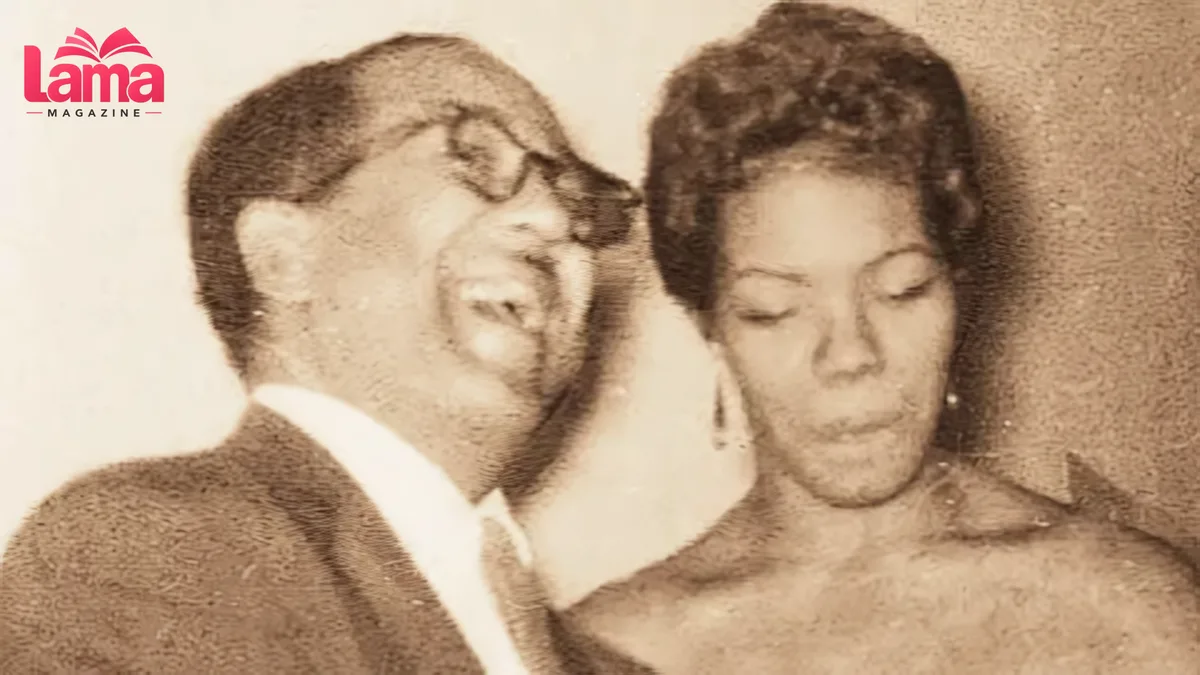
What cannot be reconstructed responsibly is a detailed account of his activities after their separation. Those gaps should remain gaps rather than becoming invented chapters of a life story.
Conclusion
Tosh Angelos was Maya Angelou’s first husband and a father figure to her young son during a brief marriage in the early 1950s.
Her own recollections show both the qualities she admired in him and the independence she sought after their relationship ended.
His most visible legacy in the public record is the surname that became “Angelou,” a name the writer later made unmistakably her own.
Frequently Asked Questions
1. When did Maya Angelou marry Tosh Angelos?
Biographical sources variously date their wedding to 1949, 1950, or 1951; no single year is consistently established.
2. When did Maya Angelou divorce Tosh Angelos?
Published accounts place their divorce in the early 1950s, with 1952 and 1954 both reported.
3. How did Tosh Angelos influence Maya Angelou’s name?
Maya adapted his surname, Angelos, into Angelou and combined it with the childhood nickname given by her brother.
4. What was Tosh Angelos’s nationality?
He is consistently described as being of Greek descent, but authoritative sources provide limited citizenship details.
5. When did Tosh Angelos die?
Established biographical references do not consistently document his death date, so an exact date should not be asserted.
We Also Eecommend Reading This Article For More Useful Information: How HCS 411Gits Software Built: Features, Updates & Error Codes

1 Comment
Pingback: Who Is Wendy Etris? All About AJ Styles’ Wife